

Application mapping is no longer just a simple software inventory. In today’s environment, where information systems are increasingly complex and interconnected, combining SaaS solutions, business applications, microservices, and hybrid infrastructures, having a clear, structured, and actionable view of your IT landscape has become a strategic necessity.
For CIOs, CISOs, enterprise architects, and business leaders, application mapping goes far beyond documentation. It enables organizations to drive transformation, secure critical data flows, optimize IT costs, and align technology with business strategy.
In this context, solutions like myCarto bring real value. They allow organizations to build a dynamic, multi-layered, and collaborative application map that becomes a true decision-making and governance tool.
What is application mapping?
Application mapping consists of creating a structured representation of all applications within an information system, including their interactions, technical and functional dependencies, and their relationship with business processes and capabilities.
However, a truly effective application map goes far beyond listing tools. It provides deep insights into how the system operates by helping organizations:
- identify critical application flows
- visualize technical dependencies and potential risks
- detect functional redundancies
- assess application criticality and lifecycle
- anticipate the impact of transformation projects
In that sense, application mapping becomes the backbone of IT governance.
With myCarto, this representation becomes interactive and multi-layered. Each application is connected to the processes it supports, the data flows it exchanges, the infrastructure it relies on, and the teams responsible for it. The map evolves from a static diagram into a living, continuously updated reference system.
Why application mapping has become essential
1. Managing growing IT complexity
Modern information systems evolve constantly, often in response to immediate business needs. Over time, this leads to an accumulation of applications, functional overlaps, and a loss of global visibility.
Application mapping helps organizations regain control by providing a clear overview of the IT landscape. It enables teams to rationalize the application portfolio, identify redundancies, and simplify overall architecture.
With myCarto, this process is enhanced through intuitive visualizations of dependencies and usage, making complexity easier to understand and manage.
2. Securing data flows and strengthening cybersecurity
For CISOs, application mapping is a key tool for understanding the organization’s exposure surface. It provides visibility into critical applications, sensitive data flows, strategic dependencies, and potential risk areas.
By centralizing this information, myCarto delivers a consolidated and reliable view of the information system, making it easier to conduct impact analyses, manage risks, and support compliance initiatives.
3. Driving transformation and reducing technical debt
Every IT transformation, whether cloud migration, ERP implementation, or application modernization, creates ripple effects across the system.
Without a reliable map, these impacts are often underestimated, leading to increased risks and costs. Application mapping allows organizations to visualize these dependencies, anticipate cascading effects, and prioritize projects based on business value.
With myCarto, teams can rely on a continuously updated view of the system, enabling them to simulate changes, assess impacts, and make informed decisions.
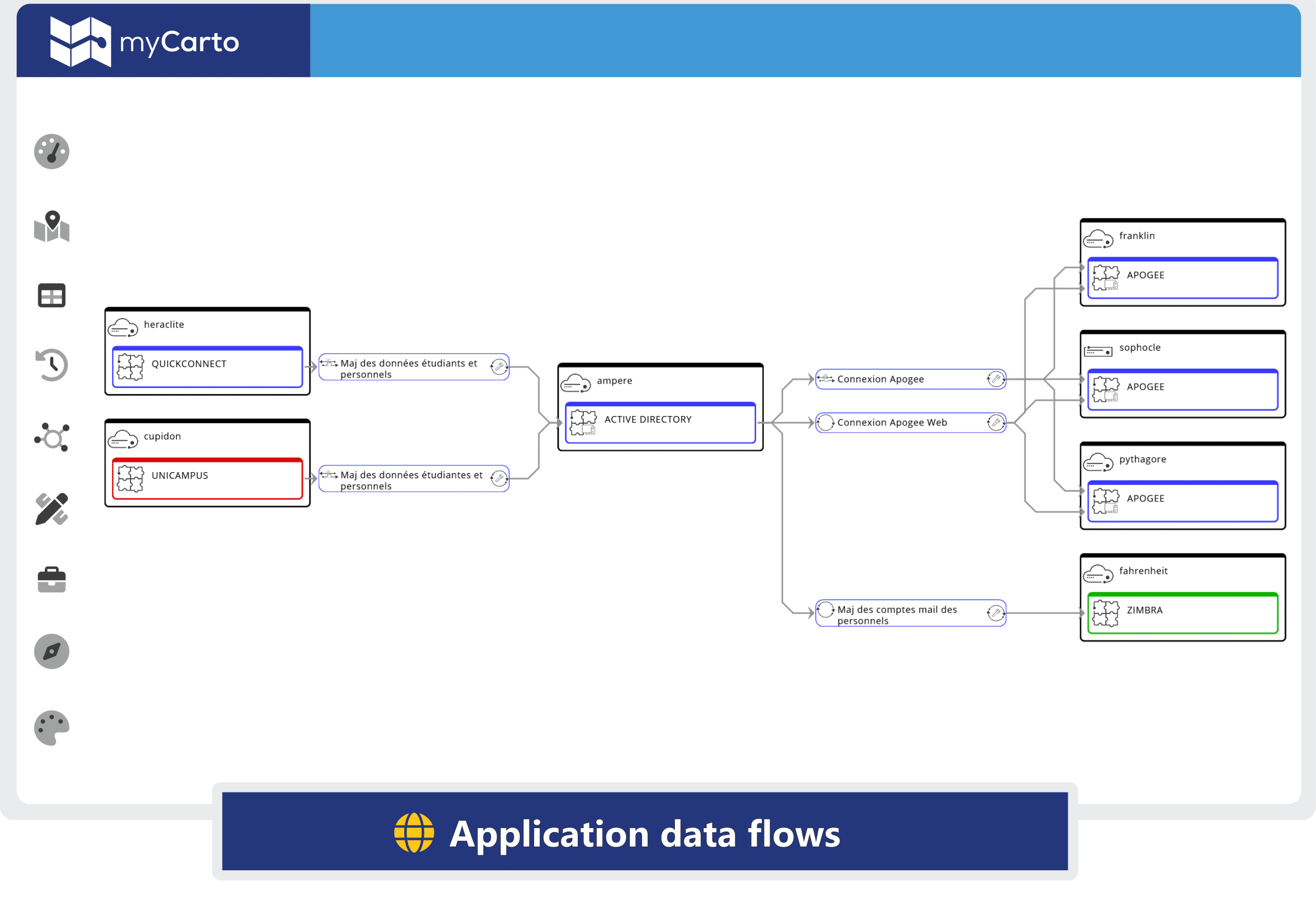
The four key layers of an effective application map
To be truly strategic, application mapping must integrate multiple layers of analysis.
It connects business capabilities and processes to the applications that support them, details the functional services delivered, describes the application portfolio (including lifecycle and ownership), and maps the underlying technical infrastructure such as hosting, databases, and dependencies.
The strength of myCarto lies in its ability to connect these layers, offering a holistic and dynamic view of the information system, accessible to both technical teams and business stakeholders.
Application mapping and IT architecture governance
Application mapping is a foundational element of enterprise architecture and IT urbanization. Without it, systems tend to evolve in an unstructured way, driven by short-term needs, leading to complex and difficult-to-manage architectures.
By structuring interactions, clarifying responsibilities, and visualizing data flows, application mapping enables organizations to evolve their IT systems in a controlled, coherent, and strategic manner.
In this context, myCarto plays a central role by providing a shared reference framework for all stakeholders. This common view improves communication, aligns teams, and supports faster, more informed decision-making.
Why myCarto stands out for application mapping
While many organizations still rely on Excel files, static diagrams, or scattered documentation, these approaches quickly become outdated and difficult to maintain. As a result, the mapping loses reliability and is no longer used as a decision-making tool.
myCarto addresses these challenges directly.
By centralizing all application data into a single, unified repository, it provides a consistent, shared, and continuously updated view of the IT system. Applications, flows, dependencies, and infrastructures are interconnected, allowing users to easily navigate complexity and quickly identify risks.
Beyond visualization, myCarto turns application mapping into a true governance tool. Organizations can rationalize their application portfolio, track transformation projects, and prioritize initiatives based on business value.
Its collaborative approach also brings together CIOs, architects, CISOs, and business teams around a common and reliable source of truth. With continuous updates and operational usage, mapping evolves from a one-time exercise into a living process embedded in daily IT operations.
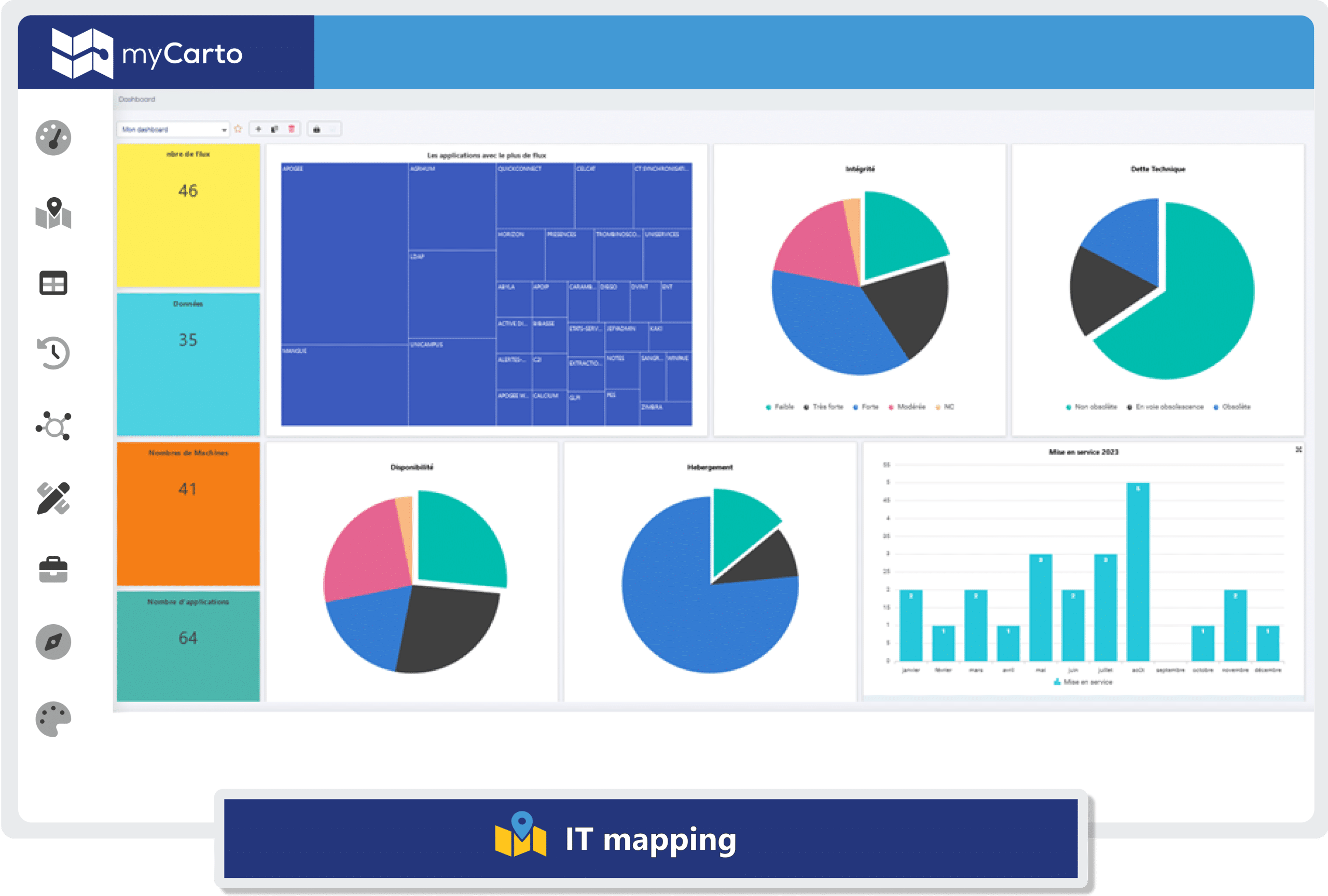
Experience the power of dynamic application mapping
Conclusion
Application mapping has become a critical strategic lever for governing, securing, and transforming information systems. It provides the global visibility needed to manage complexity, reduce risks, and optimize IT investments.
Organizations that rely on solutions like myCarto go beyond documentation. They gain a powerful decision-making tool that supports transformation and aligns IT with business objectives.
In an era of ever-increasing technological complexity, adopting dynamic application mapping is no longer optional, it is a key condition for sustainable performance and control.