

Andra with myCarto
Mastering and Streamlining a Complex Information System in a Highly Regulated Environment


Andra is…
- The French National Agency for Radioactive Waste Management
- Main mission: securing radioactive waste produced in France to protect current and future generations
- 3 storage centres (Manche and Aube) and one underground laboratory (Meuse/Haute-Marne) on French territory
- Around 800 employees
- An Information Systems and Digital Department (DSIN) of about thirty people
- 350 applications documented in the IS mapping
Objective: Master and streamline a complex Information System in a highly regulated context
Discover how Andra structured its enterprise architecture using myCarto to map, manage and optimise a portfolio of 350 applications in support of a demanding and highly regulated public-interest mission.
The French National Agency for Radioactive Waste Management (Andra) is a public industrial and commercial establishment carrying a crucial mission: ensuring the long-term management of French radioactive waste. Andra operates three storage centres and is preparing the Cigéo project, the future deep geological repository for the most radioactive waste.
In such a demanding context, where nuclear regulation requires strict traceability, the Information System plays a central role. Until 2020, this IS was characterised by strong autonomy within business units, with locally developed applications, a fragmented application landscape, and a limited global view.
A Transformative Digital Shift
In 2020, Andra launched a major digital transformation. This resulted in the creation of the Information Systems and Digital Department (DSIN). The DSIN brings together about thirty employees working on business application development, enterprise architecture and centralisation of IT expertise.
This transformation also brought the creation of an enterprise architect position. Its role: structure the IS architecture, model business processes and ensure the coherence of the application portfolio.
Stéphane DELYSSE-HOFMAN, CIO and former enterprise architect at Andra, highlights the importance:
“Today, you can’t operate without an enterprise architect. It has become an essential component.”
The Challenges of IS Mapping in the Nuclear Sector
- Regulatory compliance: Meeting ANSSI requirements and strict nuclear regulations requiring precise knowledge of the IS.
- Fragmented vision: Historically, each department managed its own IT tools autonomously.
- 360° visibility: Mastering an IT landscape extends far beyond infrastructure and applications. It is a constantly evolving asset whose health must be continuously monitored.
- Complex maintenance: Difficulty identifying owners, flows and dependencies between applications.
- Frequent audits: Repeated regulatory audits requiring up-to-date and reliable documentation.
A first IS mapping had been implemented in a tool that did not provide satisfaction. Updates were laborious. It required heavy training and complex deployment on users’ workstations. Publishing to the intranet was not automated.

The update process was much more complex with our previous tool. If business teams reduce their involvement in updates, the quality of your information automatically degrades.»
Stéphane DELYSSE HOFMAN – CIO of Andra

Switching to myCarto: A Strategic Choice
- Ease of use and ergonomics
- Automated intranet publication
- BPMN compatibility for business process modelling
- French solution adapted to a mid-sized organisation
- On-Premise deployment to meet security requirements
The choice fell on SoluQIQ (now myCarto), positioned between simple tools and market giants requiring dedicated teams.
“What really stands out is the simplicity—you don’t need 3 weeks of training to start using myCarto.”,
notes Arnaud MARCHESI – Enterprise Architect.
When myCarto released its fully BPMN-compliant module, the team decided to take a step further.
“Switching to myCarto really allowed us to level up in how we model business processes.”
A Collaborative and Progressive Implementation
Automation and Integration
To ensure mapping reliability, Andra implemented several automations:
- CMDB connection: Deployed machines automatically update the mapping every night
- ITSM link: Synchronisation with the incident and service management tool
- APIs and workflows: Integration with DSIN tools to avoid manual entry
The “on the way” tip
“Automate as much as possible—don’t rely on humans.”, recommends Arnaud MARCHESI.
“When we have to answer a question or a business request, we do it through the mapping. It allows us to document, capitalise and enrich our knowledge.”, adds Stéphane DELYSSE-HOFMAN.
Mobilising Stakeholders Around the Mapping
Several roles within the DSIN and business units contribute to the mapping:
- Business Partners: Attached to the DSIN, they are the bridge between business and IT. Trained in BPMN, they model business processes directly in myCarto.
- Project Managers: Trained for autonomous updates.
- CISO: Driving force in the initial approach; relies on the mapping for risk analyses.
- Managed Services Provider: Uses the mapping as a reference to understand applications and their dependencies.
- Enterprise Architect: Oversees global coherence and progressively enriches the model.
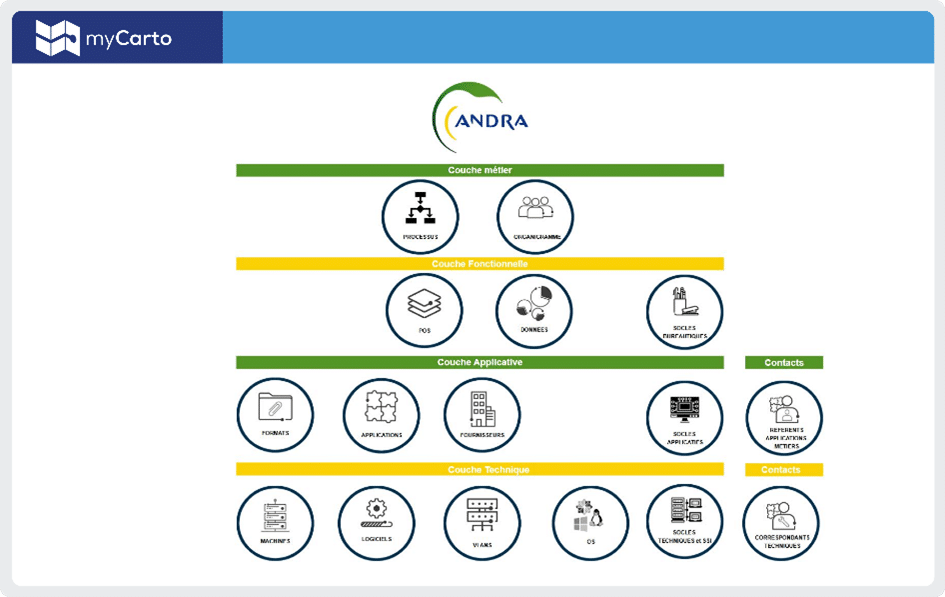
An Incremental Approach to IS Mapping
- Application layer: Inventory and documentation of the 350 applications
- Infrastructure links: Connecting applications to servers
- Business processes: Progressive BPMN modelling
- Inter-application flows: Documenting exchanges between applications
- Data: Currently being deployed on pilot scopes
I believe it’s better to adopt an incremental approach and not hesitate to start small to clearly demonstrate the value of the tool before saying, ‘I’m going to map everything’»
Arnaud MARCHESI – Architecture

Concrete Uses and Benefits of myCarto at Andra
The “Rosetta Stone” Between Business and IT
A powerful metaphor summarises the role of mapping:
“The Rosetta Stone that allows business teams to speak with IT.”
Mapping bridges the gap between:
- Business teams who speak in “application names”
- Infrastructure teams who speak in “server names”
- Business Partners who translate into processes
Support for Regulatory Audits
In the nuclear sector, audits are frequent (Court of Auditors, safety authorities, etc.). The mapping becomes a proof and reassurance element.
“During audits, we meet regulatory requirements by demonstrating—supported by documentation—that a given process is clearly identified and supported by a specific application.”
The team even configured in myCarto an automatically calculated obsolescence indicator, based on several criteria (criticality, version, maintenance), providing instant visibility on application health.
Facilitating Work with the Managed Services Provider
When Andra changes service provider, it is a critical moment where mapping demonstrates its full value.“When working with a new provider, mapping is a key asset. It allows you to build the entire documentation corpus, find an application regardless of its naming, identify the business contact, and understand the infrastructure components attached to it. For the provider, it’s an essential tool to navigate an IS they don’t yet know.”
— Stéphane DELYSSE-HOFMAN
This agility helped ensure business continuity and even improve operational quality.
Impact Analysis and Operations Management
The mapping of inter-application flows enables precise impact analyses.
“Thanks to the mapping, we can carry out very precise impact analyses to identify all consequences, direct or indirect, caused for example by stopping a machine or application.”
— Arnaud MARCHESI
Practically, when the infrastructure team plans maintenance on a server, they can:
- Identify all hosted applications
- Trace impacted business services
- Identify stakeholders to notify
- Plan operations at the least disruptive time
Rationalisation and Cost Optimisation
IS mapping plays a key role in optimising the application portfolio. Arnaud MARCHESI gives two examples:
“We avoided a purchase of more than €60K. This was possible by identifying a platform capable of addressing several business cases for which new digital tools were requested.”
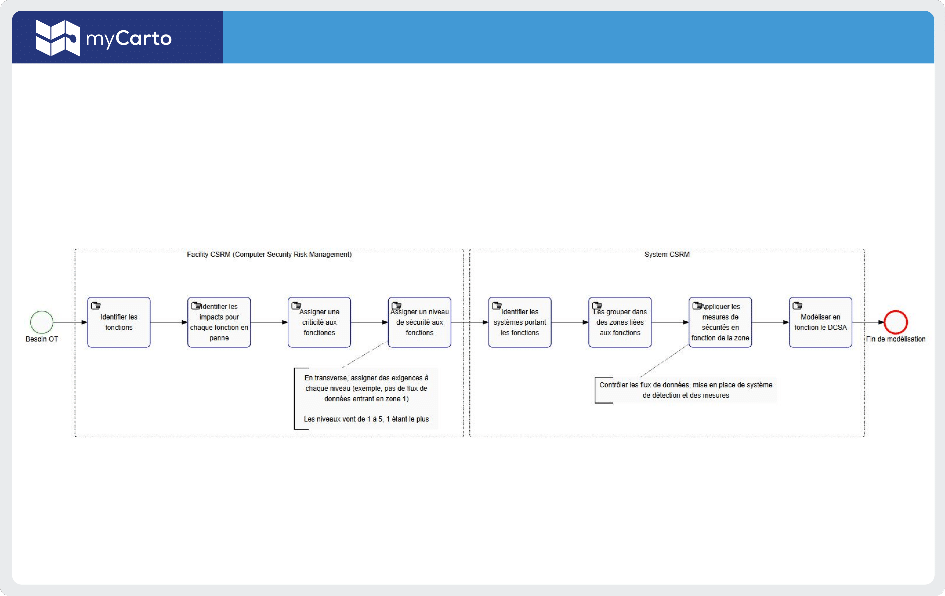
By modelling business processes, the team identified that an already acquired solution could meet the needs of another department, avoiding redundancy.
On a storage site, an innovation initiative revealed misunderstandings between teams. Some thought existing tools were sufficient, others identified missing features.
“By mapping their processes, they better identified uncovered areas and missing functionalities. This exercise truly acted as a revelation, facilitating dialogue and understanding of real business needs.”
Keys to Successful Mapping at Andra
Strong Executive Sponsorship
The CIO’s background as a former enterprise architect strongly facilitates the initiative. Legitimacy and support are ensured from the start.
Governance Integrated into Project Processes
Andra strengthened its project management processes:
A project cannot be closed in the portfolio unless the mapping is up to date. This rule ensures the reliability of the repository.
A mandatory deliverable, the “technical architecture document”, must be provided for any architectural modification.
Data Quality as an Obsession
“Mapping involves managing a large volume of data. You must stay selective, but everything documented must be kept up to date. Without this rigour, the credibility of the map collapses.”
The team made pragmatic choices: not putting everything in the mapping (for example, contract deadlines are managed in another dedicated tool), but ensuring that what is documented is reliable.
Training and Contributor Autonomy
- Business Partners trained in BPMN by external organisations
- Project Managers trained to enter data in myCarto
- Creation of a culture where everyone understands their role in mapping
An Incremental and Pragmatic Approach
Rather than targeting immediate exhaustiveness, the team expanded progressively:
- A demonstrator on “packages” (Andra’s main asset) to illustrate the data model’s relevance
- Quick wins on concrete projects
- Gradual scaling up of functionalities
Andra’s Advice for Successful Mapping
- Don’t do it alone
“Mapping cannot rest solely on one architect or manager; it must be supported by the entire IT department.” – Stéphane DELYSSE-HOFMAN
- Choose a user-friendly tool
Avoid an all-in-one solution if the team is not sized for it.
- Automate as much as possible
Reduce manual entry by leveraging existing repositories and APIs.
- Adopt an incremental approach
Start small, demonstrate value, then gradually expand.
- Guarantee data quality
A non-negotiable condition for credibility and adoption.
Perspectives and Ambitions
The team continues to enhance the mapping:
- Expansion of the data model to other business domains
- Strengthening the link between myCarto and ITSM
- Creation of governance instances dedicated to architecture
- Preparation for major transformation projects such as Cigéo
“It’s a solution that evolves well. AB+ Software takes customer feedback into account. Support is responsive. The arrival of myCarto represents a very significant technological leap.”
Stéphane DELYSSE-HOFMAN
Additional Information
Discover all of Andra’s activities on their official website: Andra – Radioactive Waste Management